

The Northumberland Fusiliers and WW1
March Meeting Report
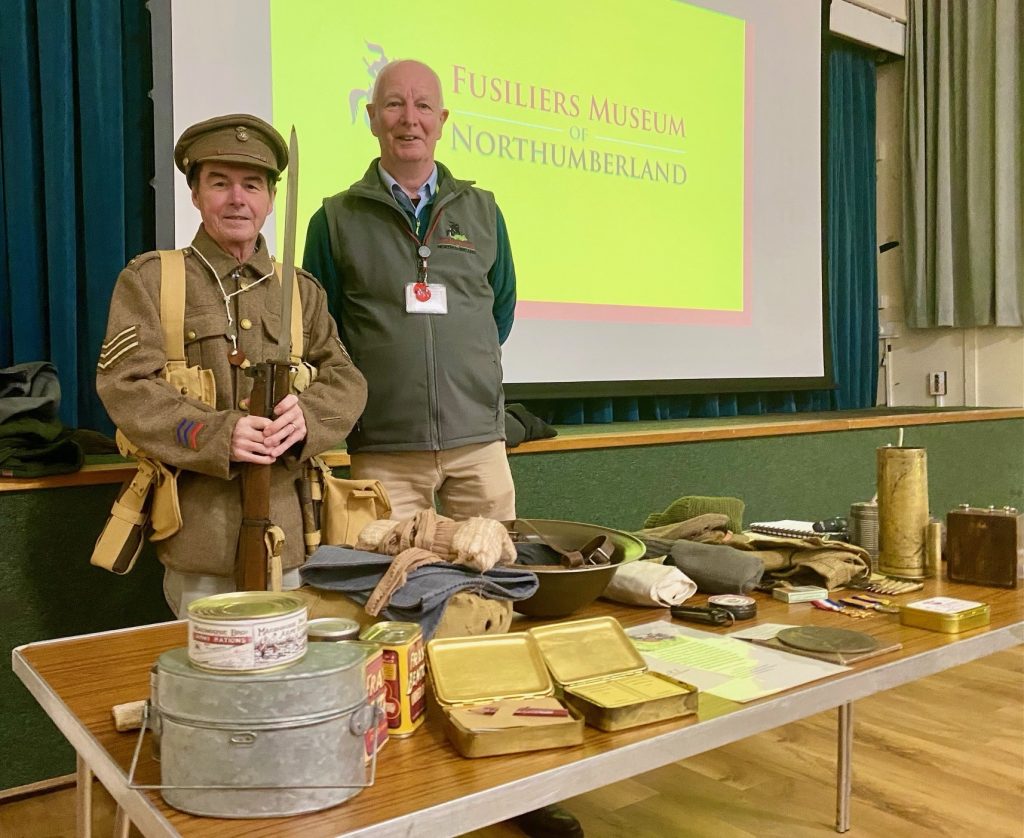
On Monday 2nd March Mark Stafford and David Smith from the Fusiliers Museum of Northumberland gave a talk on the history of the Northumberland Fusiliers and the part they played in World War I.
They were first formed in 1674 to fight in Holland under William of Orange, when they were known as the 5th Foot Regiment. In 1782 they became the Northumberland Regiment of Foot and in 1935 were named the Royal Northumberland Fusiliers to mark the King’s Silver Jubilee. At the beginning of WWI the regiment raised 52 Battalions comprising over 100,000 men, of whom 17,800 were killed and 40,000 wounded. Because of the many head injuries, their uniform soft caps of 1914 were replaced with steel helmets in 1916 just before the Battle of the Somme. They also wore two dog tags, one to be taken back to headquarters in cases of death, the other to remain with the body for identification by the burial party.
The German army first used gas attacks in 1915, contrary to the Geneva Convention. At first, field dressings were placed over the face as the only means of protection. Then a hood impregnated with chemicals was introduced, later to be replaced by gas masks with built in respirators. Before the introduction of hand grenades in 1915, jam tins would be filled with shrapnel and fitted with a fuse.
To avoid enemy fire soldiers in the trenches would sleep during the day and work at night. Hot food was carried to the trenches in hay boxes, whilst for breakfast and lunch dry rations were placed in sand bags.
The aim in 1914 was to get casualties off the battle field within one hour. Cleanliness was of the utmost importance to prevent infections. As well as emergency field dressings, each soldier would carry a medical card with details of any treatment received.
The youngest Fusilier to be killed in action was Private William Stewart at the Battle of the Somme in 1916, aged just 15. The oldest, also at the Somme, was Lieutenant Colonel Charles Sillery aged 54.
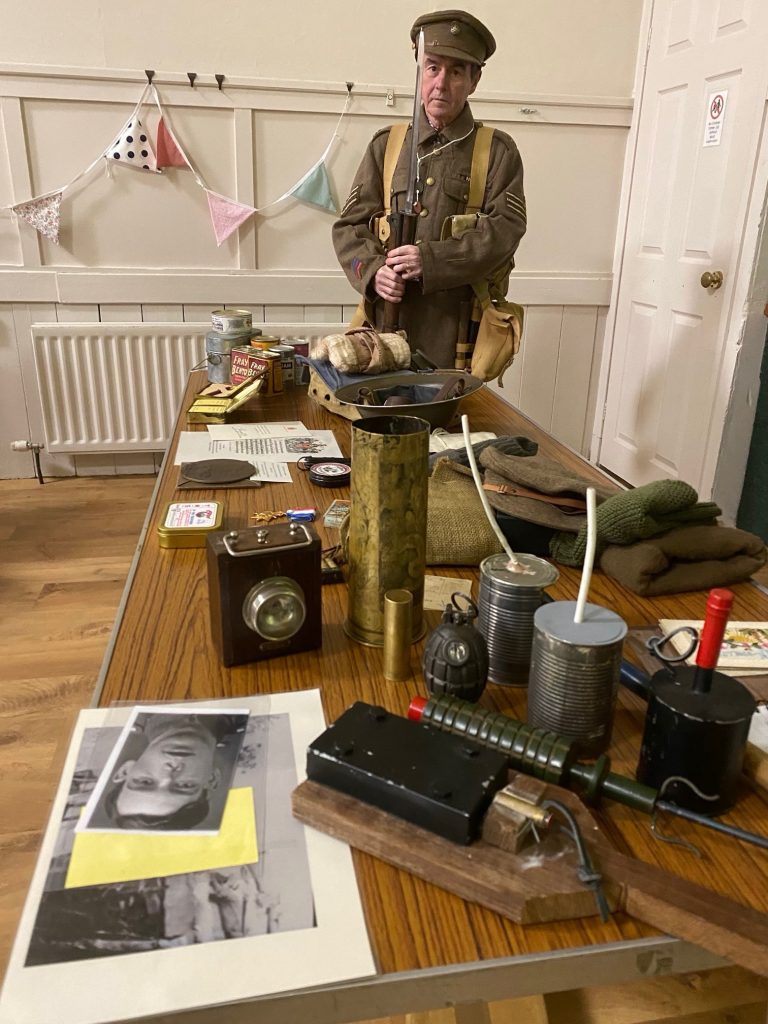
Mark and David brought this talk vividly to life with the many artefacts, original uniforms, pieces of equipment, field rations etc. which the audience had the opportunity to inspect for themselves, bringing home to us what life on the front line must have been like for the brave soldiers of the Northumberland Fusiliers.
Report by Kathryn McLachlan