

Turkey, Sprouts and Mince Pies: How British is a Christmas Dinner?
December 2025 Meeting Report
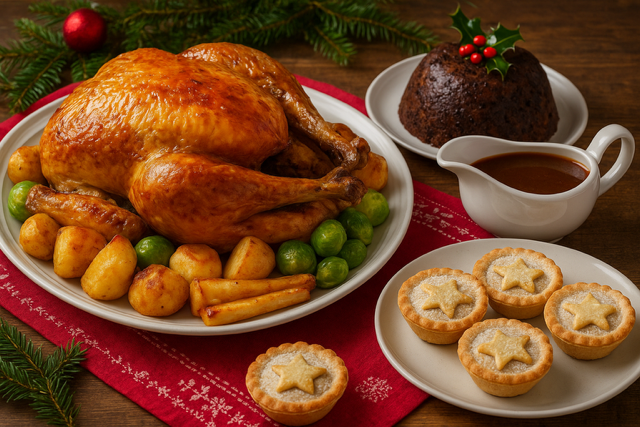
For our December meeting Sue Brown was invited back, this time to talk about the history of Christmas food. Of course mid-winter feasts predate the celebration of Christ’s birth, but from the 4th century Advent became a time of fasting followed by a period of plenty lasting from December 25th until January 12th. However, this was mostly restricted to the wealthy, whilst their leftovers were distributed to the poor.
By the 15th and 16th centuries tenant farmers were invited into the manor house, bringing with them ingredients such as eggs and poultry. Other food at the table included stuffed boar’s head and brawn whilst gifts of apples and pears were exchanged on January 1st.
In the C17th the charitable sharing of food had declined and the Puritan-dominated Parliament decided that over-indulgent feasting by the wealthy, whilst the poor went hungry, was not an appropriate way to celebrate the birth if Christ. Christmas Day was to be a day of fasting and prayer.
With the Restoration of the monarchy however Christmas celebrations were also restored. But by then the old ways were seen as unfashionable. The C18th and early C19th were a time to display one’s wealth by providing food such as beef, venison, goose, oranges, dried fruit and spices. Turkey from America was also becoming popular and plum pudding (to be served alongside the meat) was first mentioned in 1723. The emphasis was on quantity and variety to show one’s status.
It was in the Victorian era that a family centred Christmas became popular once again. The traditional Christmas dinner of roast turkey or goose was established, with seasonal vegetables like potatoes, sprouts, carrots and parsnips, and Christmas pudding.

This continues for many of us into the C21st, but frozen and ready-prepared ingredients are now convenient options as life for the average family has become increasingly hectic. Those with time and money to spare have become more adventurous with their cooking methods and ingredients. And the charitable sharing of food continues through the work of food banks and other organisations, not just at Christmas now but throughout the year.
Sue’s talk was both enlightening and thought provoking in the way that it linked the humble (and not so humble) Christmas dinner to the changing moods and behaviours of our predecessors, and perhaps made us reassess our own attitudes to this increasingly commercial time of year.
Report by Kathryn McLachlan